
The Face of Truth | Ibrahim Shaglawi “Hisān Al-Bayāḥa” Unveils Our Hidden Wars?

What if the National Theatre were to resume its activities with the play “Hisān Al-Bayāḥa”?

This question is not merely about choosing an opening performance; it is a test of Sudan’s ability to confront itself after the war, to reread its history and identity, and to restore the national cohesion torn apart by conflict and systematic violence. The rehabilitation of the National Theatre in Omdurman is an attempt to reintroduce imagination, memory, and the collective conscience into the heart of the state and society, and to revive the role of theatre as a critical platform and a space for re-establishing national and social values.
The play “Hisān Al-Bayāḥa” is an artistic document that records the life of a Sudanese society during the period of the Funj Kingdom, and recalls pivotal historical moments that shaped the contours of Sudanese national identity. Through its theatrical tableaux, the performance evokes political authority, legislation and religion, social practices, and perceptions of women, in a critical manner that exposes internal conflicts between power and justice, and raises fundamental questions about authority and society.
In the Sudanese context, theatre has never been merely an artistic platform; it has always been a vast space of creative expression where questions of power, identity, and collective memory collide. From here, the question of inaugurating the National Theatre with “Hisān Al-Bayāḥa” goes beyond artistic taste to become a profoundly political question: which national narrative do we wish to begin with in the post-war phase?
Dr. Yousif Eidabi, the playwright, represents the founding generation of the modern Sudanese theatre movement. Through his works, he sought to present a theatre that blends African and Arab cultures, transforming heritage into a critical and artistic tool for reflecting on the present and the future. His works did not offer ready-made solutions; rather, they placed the audience before existential and political questions, providing space for self-critique and national accountability.
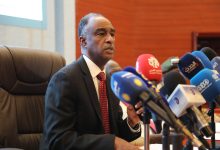
The visit of the Undersecretary of the Ministry of Culture, Information, and Tourism, Dr. Graham Abdel Qader, yesterday to the National Theatre rehabilitation project, and his praise of the role of theatre in confronting hate speech, reflects an awareness of the importance of culture in healing society. Yet this awareness remains incomplete unless the deeper question is raised: does the state return through theatre as an authority, or as a political and moral project capable of acknowledging its failures?
A state that reopens the theatre without allowing it to pose painful questions merely restores the façade, not the substance. But a state that accepts theatre as a space for critique, accountability, and an alarm bell is the only one that truly has a chance to rebuild trust with a society exhausted by disappointments and deeply wounded by betrayal.
Opening the National Theatre with this play is not a neutral cultural event; it is a declaration of the readiness of society and the state to confront themselves, to define the war as an existential one for restoring awareness, and to expose the network of internal and cross-border economic and political interests that laid its foundations, along with the tools used to dismantle the state and society.
The play establishes difficult questions, not entertainment.
It takes us back to the era of the Funj Kingdom, a pivotal moment in the formation of the Sudanese self, when authority was still in the making, identity was under negotiation, and cultural and religious diversity was part of daily life. Yet the strength of the text lies not in summoning the past, but in revealing it as a tense time, full of unresolved conflicts.
This tension is what gives the play its urgency today. Contemporary Sudan is experiencing a similar crisis, but with far more violent tools: multiple centers of power, the absence of a unifying national reference, and the collapse of the political space in which disagreements were once managed through words, stories, and national forums—not through weapons and allegiance to foreign interests.
In “Hisān Al-Bayāḥa”, disagreement was managed within a social structure, despite its fragility, through language, ritual, and religious interpretation. In the reality of the current war, this structure has collapsed, and the Rapid Support Forces militia has filled the void. In this context, the militia does not represent merely a rebellious military faction, but a political outcome of a long-term collapse in the structure of the state, and its failure to manage diversity and protect society.
The widespread violations committed by the Rapid Support Forces militia against Sudanese women reveal the harshest face of this collapse. Systematic sexual violence, rape, enslavement, and displacement are not merely war crimes; they are political tools to break societies from within. In Sudanese social structure, women represent the axis of the family and the guardians of memory and values; targeting them is a direct assault on the social, political, and moral fabric.
Here, “Hisān Al-Bayāḥa” intersects with the present in a painful way. The struggle over the status of women, which the play reflects as part of social formation, turns in times of war into brutal practice, after women have been stripped of their humanity and their bodies used as weapons to humiliate society.
Returning to theatre is considered a lever for restoring national cohesion. It gives society the opportunity to reclaim critical imagination, grants the individual a space for review, and encourages rethinking the other and the self, as well as collective solidarity, away from hate speech and zero-sum conflicts. Theatre does not confine itself to performances; it contributes to repairing the social, political, and psychological fabric torn apart by war.
According to #The_Face_of_Truth, “Hisān Al-Bayāḥa” becomes a mechanism of political and cultural analysis, linking past and present, and placing the right questions before those who lead the state and society: How do we return the state to its natural place as a protector of rights? How do we prevent the repetition of war? How do we restore the human being as the center of decision-making? The play asserts that the crisis lies not only in individuals, but in the social and political structures that allow mistakes to be repeated, reproduce violence, and turn society into a target of humiliation rather than a leader of renaissance.
Wishing you continued health and well-being.
Tuesday, 30 December 2025
Shglawi55@gmail.com