
The Voice of Truth | Dr. Ibrahim Shaglawi Moscow and Khartoum: From

Sudanese-Russian relations, spanning seventy years, represent an important asset for Sudan. President Al-Burhan’s visit to Moscow was seen as an opportunity to strengthen these relations and rebuild the partnership on the basis of mutual interests, enabling Sudan to leverage its resources and geopolitical position in shaping a relationship that goes beyond promises to deliver tangible national gains while preserving Sudanese decision-making independence.
The most notable outcome of the visit was that President Al-Burhan presented Moscow with a package of investment opportunities covering energy, mining, agriculture, health, and education. He also proposed establishing a free economic zone on the Red Sea coast, which Russia could use for storing fuel and wheat, alongside the participation of Russian companies in developing the railway network and building supply chains for transporting goods.
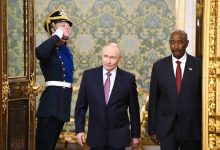


These proposals deserve consideration, as Sudan offers a strategic location that could become a logistics gateway connecting Russia to African markets and providing it with an important outlet onto the Red Sea, one of the most sensitive maritime corridors in global trade. Storing wheat and fuel in a free economic zone could also create added value beyond the boundaries of trade exchange if linked to ports, maritime transport, railways, and production and consumption areas.
What is striking is that the importance of this proposal lies in placing the country’s resources at the heart of the equation of interests, rather than leaving them as untapped geographical and economic advantages. Ports, minerals, agricultural land, and transport constitute components of an integrated economic project that could restore Sudan’s role in regional and international trade. However, it is essential to have the vision necessary to turn these assets into reality in a way that serves the country’s interests.
Here we arrive at the most important challenge: the problem is not the absence of opportunities, but how the state manages them. The executive apparatus does not operate independently of the political leadership. Therefore, the success of what Al-Burhan proposed depends on a clear political will and executive bodies with the expertise and capacity to negotiate, plan, and follow up, and to turn understandings into agreements with timelines, legal guarantees, and measurable performance indicators. Major investments are managed through institutions.
However, there is a deeper issue concerning the prioritization of the partnership. Sudan is engaged in a prolonged war and faces challenges related to its national security, the survival of its institutions, and its defense capabilities. Under such circumstances, it is difficult to separate economic cooperation from security and military considerations. Companies investing in mining, energy, and ports need a secure environment, while infrastructure projects require political and security stability to ensure their continuity.
Hence, discussion of a strategic partnership should not stop at investment in gold and copper or the establishment of wheat and fuel storage facilities. It should extend to building clear defense and security cooperation, including developing the capabilities of the Sudanese Armed Forces, technology transfer, training, defense industries, and securing vital facilities and infrastructure in light of regional drone warfare. The integration of security and development is a fundamental condition for protecting and sustaining economic interests.
In this context, the issue of the Russian naval base on the Red Sea returns to the forefront of discussion as one of the most prominent matters historically associated with negotiations between the two countries. This issue cannot be addressed temporarily; rather, it requires a political and legal resolution based on an assessment of national interests, given that it is an important decision whose implications extend beyond military cooperation to the country’s security, its position in the Red Sea equation, and the nature of its regional and international relations.
Therefore, it would be unwise for Sudan to make its decisions under pressure from American concerns or the calculations of Washington’s allies in the region. Russia, like other international powers, acts according to its interests, and Sudan is expected to do the same. What is required is to formulate an arrangement that achieves mutual interests, preserves national decision-making, and ensures that ports, resources, or military arrangements do not become commitments that undermine the state’s freedom to manage its regional and international relations.
Notably, Putin expressed his readiness to cooperate. He also spoke of a roadmap for developing relations, pointed to the need to remove obstacles, and indicated that Russian companies were prepared to enter into partnerships in energy, agriculture, minerals, and education. He also affirmed his country’s support for stability, ending the war, and achieving peace. These are important political signals as the process moves from understandings to contracts and implementation.
From the perspective of The Voice of Truth, the importance of rapprochement with Moscow lies in Sudan’s ability to leverage its geopolitical position to strengthen its national interests, expand its economic options, and develop its defense capabilities. Sudan is a country whose geography and resources qualify it to be an active partner in shaping its own interests.
Therefore, the outcome of Al-Burhan’s visit will not be measured by the promises it brought, but by what the state accomplishes through agreements and projects that move the relationship from political rapprochement to mutual interests. A strategic location alone does not create influence unless supported by an independent national vision capable of making effective use of these geopolitical advantages.
Wishing you continued well-being.
Sunday, November 1, 2026
Shglawi55@gmail.com